 Zhcloudlink
Home / News / Video Basics: What Is GB/T 28181?
News
Video Basics: What Is GB/T 28181?
GB/T 28181 comes up often when an AI edge box or server is connected to camera streams. This note explains what the standard is, how the signaling works, and what a platform built on it usually includes.
When an AI edge box or server is networked with camera streams, GB28181 comes up often. What is it?
The full name of GB/T 28181 is Technical requirements for information transport, switching and control in video surveillance network system for public security. It is a national protocol issued by the Ministry of Public Security of the People’s Republic of China for networked public-security video surveillance, and it is a mandatory standard for security cameras.
1. Goals
Interoperability. Cameras (front-end devices), network video recorders (NVRs), and video surveillance platforms (back-end software) from different vendors can connect through one protocol.
One signaling protocol and one media protocol: control signaling is built on SIP, and audio and video are carried with RTP/RTCP.
Large networks: the design fits a hierarchy of province, city, county, and township.
Security that can be controlled: device authentication, signaling encryption, access control, and related mechanisms.
2. Editions
GB/T 28181-2011: the first edition. It set the networking architecture and the base protocol.
GB/T 28181-2016: the edition in force. It revises and extends the 2011 text, including more media formats, stronger security, and a cleaner signaling flow. It is the edition widely deployed today.
A 202x edition is being drafted. It is expected to add IPv6, commercial-cryptography algorithms, AI metadata, cloud-edge coordination, and other new features.
3. Technical architecture
| Role | Description |
| SIP client (for example an IPC or an NVR) | Registers with the upper platform. Active registration and a heartbeat are supported. |
| SIP server (for example a CMS or a platform) | Device management, signaling routing, and permission control. |
| Media server | Forwards, distributes, transcodes, and stores media streams. |
| User terminal (for example a client or a video wall) | Asks the platform for video, then receives and plays the stream. |
Note: all communication uses SIP (Session Initiation Protocol). Media uses RTP/RTCP over UDP or TCP, wrapped as a program stream (PS) or, in later extensions, an elementary stream (ES).
4. Functions and protocol requirements
1. Device registration and deregistration
A lower device or platform registers with the upper platform (REGISTER).
A heartbeat keeps the registration alive (the default interval is 60 seconds).
A deregistration mechanism (DEREGISTER).
2. Live video (Play)
The user requests a live stream with a SIP INVITE.
TCP and UDP transport are supported, as is multicast (rarely used).
The media stream is wrapped as an MPEG program stream (PS), with video (H.264/H.265), audio (G.711/G.722/AAC), timestamps, frame type, and related fields.
3. Recording playback and download
Query the recording time range over SIP (Catalog).
Start playback (Play, with a Range header).
Resume, variable-speed playback, and seeking to a keyframe are supported.
4. Alarms and event notification
The device reports alarms on its own (NOTIFY).
Motion detection, masking, video loss, IO alarms, and similar events are supported.
The platform can subscribe to events and cancel that subscription (SUBSCRIBE).
5. Status reporting
The device reports status on a timer or when an event occurs (online or offline, storage status, signal quality, and similar items).
6. Voice broadcast and talkback
Voice broadcast (platform to device) and two-way talkback are supported.
7. PTZ control
PTZ commands are sent with SIP INFO or MESSAGE.
Commands are XML. Direction, speed, presets, and related controls are supported.
5. Day-to-day use
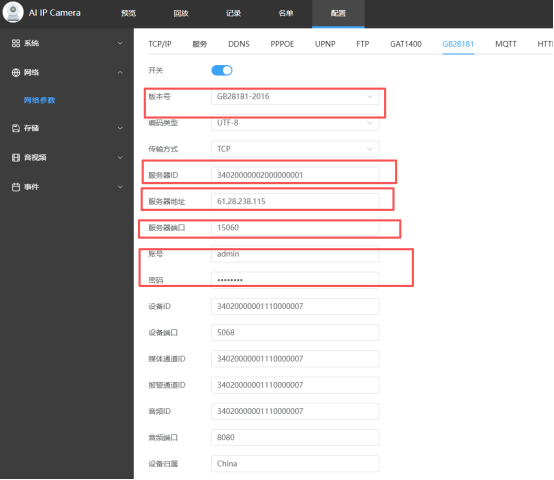
Almost every camera on the market now includes GB28181, and it can be configured on the camera.
Before that configuration, a GB28181 national-standard platform has to be set up.
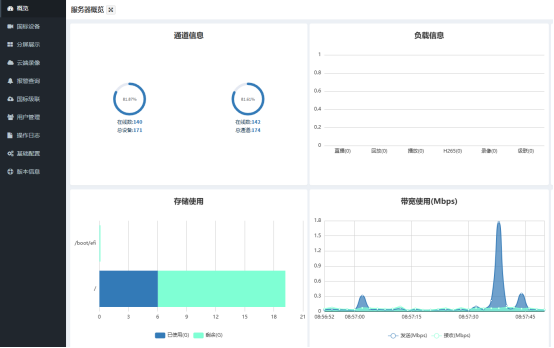
Then configure the signaling server and the streaming server:
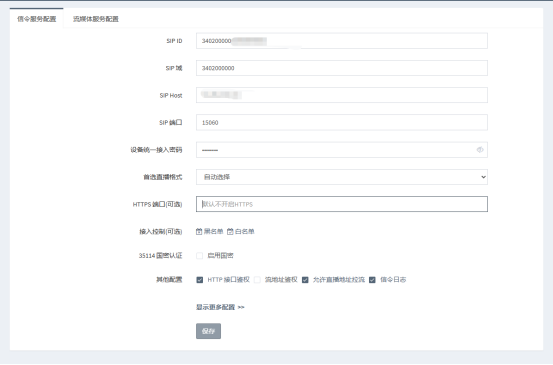
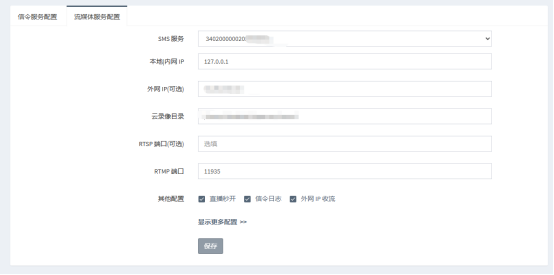
Once the connection is up, the GB28181 platform can preview live video, play recordings, talk to the camera, and so on.
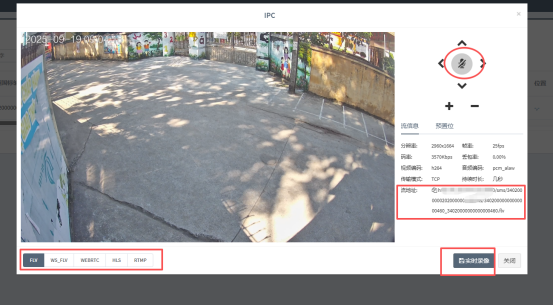
Functions a GB28181 service platform needs to include:
| No. | Module | Description |
| 1 | Server overview | Shows a summary of how the system is running. |
| 2 | Device status | Online or offline state, stream status, and related state for each device and channel. |
| 3 | Tree view | A layered directory tree, with a custom directory structure. |
| 4 | Stream protocol conversion | Turns a GB28181 stream into WebRTC, HTTP-FLV, WebSocket-FLV, RTMP, RTSP, HLS, and similar outputs. |
| 5 | UDP signaling | SIP signaling over UDP, as specified in GB28181. |
| 6 | TCP signaling | SIP signaling over TCP. The device must support GB28181-2016. |
| 7 | UDP video receive | Receives audio and video over UDP. |
| 8 | Passive TCP video receive | The camera pushes the stream to the server over TCP. The device must support the 2016 edition. |
| 9 | Active TCP video receive | The server pulls the stream from the camera over TCP. The device must support the 2016 edition. |
| 10 | WebRTC output | A low-latency WebRTC stream for live playback in a browser. |
| 11 | RTMP output | An RTMP stream, for a CDN, OBS, and similar targets. |
| 12 | RTSP output | An RTSP stream for conventional players. |
| 13 | HTTP-FLV output | An HTTP-FLV stream for low-latency playback in a web page. |
| 14 | HLS output | An HLS stream for mobile and HTML5 playback. |
| 15 | WebSocket-FLV output | A WebSocket-FLV stream for playback without a plugin. |
| 16 | Ingest statistics | Bitrate, resolution, frame rate, total data, duration, and similar figures. |
| 17 | Playback statistics | Viewer count, total playback traffic, and similar figures. |
| 18 | Live share | Creates a share link that opens and plays directly. |
| 19 | Playback authentication and signed URLs | Token or timestamp authentication, to stop hotlinking. |
| 20 | HTTPS | HTTPS for the API and for the video stream. |
| 21 | Snapshots | Captures the live picture as an image. |
| 22 | Device-side recording playback | Plays historical recordings stored on an NVR or on the camera’s SD card. |
| 23 | Device recording download | Downloads recording files stored on the device. |
| 24 | Audio on | Synchronized audio and video, switched from the UI or the API. |
| 25 | H.264 ingest | Ingests H.264 video. |
| 26 | H.265 ingest | Ingests H.265 video. |
| 27 | Integration API | A RESTful API for integration into a third-party system. |
| 28 | Message subscription | Subscribe to live device status, alarms, and similar messages through Redis. |
| 29 | Player integration | LivePlayer.js plays video in desktop and mobile browsers. |
| 30 | PTZ control | PTZ control (the camera must support it). |
| 31 | Preset patrol | Call presets and run a patrol (the camera must support it). |
| 32 | Box zoom | Electronic zoom (the camera must support it). |
| 33 | Arm and disarm | Remote arm and disarm (the camera must support it). |
| 34 | Alarm notification and reset | Receive a GB28181 alarm and reset it (the camera must support it). |
| 35 | Latitude and longitude | Read the device GPS position (the camera must support it). |
| 36 | On-demand and always-on playback | Pulls a stream on demand by default, and stops it when nobody is watching, which saves bandwidth. |
| 37 | Device allow list | Only devices on the allow list can connect, and only with the specified parameters. |
| 38 | Device block list | Blocks device ID, IP, or User-Agent entries on the block list. |
| 39 | Relay to a CDN | Pushes the stream to a CDN or a third-party RTMP server. |
| 40 | Users | Administrator, operator, and viewer roles, with permissions bound to channels. |
| 41 | GB28181 uplink cascade | This platform registers with an upper GB platform as a subordinate, which forms a cascade. |
| 42 | Live recording | Records a clip automatically while video is playing. |
| 43 | Cloud recording | The server stores recording files locally. |
| 44 | Cloud recording management and playback | Recording schedules, search, and playback. |
| 45 | Voice talkback | Two-way voice (the camera must support it, and HTTPS must be enabled). |
| 46 | Multi-bitrate transcode and relay | One input, transcoded to several resolutions and sent to a CDN or RTMP. |
| 47 | Alarm plan | An alarm automatically captures a snapshot and starts a recording. |
| 48 | Electronic map | Shows device positions on a map. |
| 49 | GM/T 35114 cryptography | Certificate authentication with SM2/SM3/SM4, as required by the public-security 35114 standard. |
Questions
What is the GB/T 28181 national standard?
The full name of GB/T 28181 is Technical requirements for information transport, switching and control in video surveillance network system for public security. It is a national protocol issued by the Ministry of Public Security of the People’s Republic of China for networked public-security video surveillance, and it is a mandatory standard for security cameras.